Investors sign hundreds of term sheets over their careers. Founders only do so a handful of times. When you’re raising money to bring your idea to life, there are a myriad of decisions you need to make — what sources of funding to pursue, how to structure your company, what timeline you should work towards. Often, these are decisions you’re making for the first time. And when you search for fundraising advice, most of what you find is directed at tech startups and told from an investor’s point of view.
We’re flipping that script. The Founder’s Guide to Funding Health and Science Organizations is a 50+ page handbook by founders Andrea Coravos and Rachel Katz, that captures their own experiences of building and successfully exiting companies, along with dozens of behind-the-scenes conversations with other health and science founders.
It covers what traditional guides leave out — how to build momentum, how to negotiate when you’re not sure you have leverage, and strategies to make funding decisions that actually align with your mission. Whether you’re exploring venture, grants, philanthropic capital, or revenue-first models, this guide is meant to help you navigate complexity and find sources of funding that let you build your company on your own terms.
At Astera, we are eager to support others who can transform their hard-won insights into public goods that enable others who are building new technologies. You can find links to this guide and other resources for startups and nonprofits on our website. Please reach out if you have insights and tools to share for guiding science and technology toward greater impact!
Contracts and business deals aren’t necessarily the first things that come to mind when you think about solving challenges in biotech and pharma, but they are a critical step in the process of commercializing new technology. Technical founders and leaders rarely learn about these crucial bottlenecks to their success until they are trying to navigate a large organization and understand the risks of particular contract terms.
Andy Coravos and Abby DeVito experienced this first-hand as leaders of HumanFirst, who built an intelligence platform for clinical research that was acquired by ICON (NASDAQ: ICLR) in 2024. Negotiating, signing, and expanding their first contracts was incredibly challenging, but they found support along the way from people willing to share their successful contracts and tips for understanding the pharma industry. Together with their legal collaborator, Shu Hu, they have built a pharma and biotech sales handbook for software founders with insights about understanding the pharma development process and organizational structure, as well as tactical advice on pricing, negotiating, and contracts.
At Astera, we are eager to support others who can transform their hard-won insights into public goods that enable others who are building new technologies. You can find links to this handbook and other resources for startups and nonprofits on our website. Please reach out if you have insights and tools to share for guiding science and technology toward greater impact!
We’re excited to announce the launch of the Nonprofit Operations Playbook, developed by Impact Ops. This resource addresses a critical gap we’ve observed in the nonprofit ecosystem – while there are abundant sources of information on mission development, programming design, and fundraising, the practical, back-office operations that keep an organization running often remain a mystery to founders.
We invested in building this resources because we noticed across our community how even with brilliant ideas and a strong mission, operational challenges can weigh down a young organization’s progress towards bringing their vision to life. With answers to even simple questions like “How do I apply for tax exempt status?” and “How should I structure and use a board of directors?” scattered across the internet, it’s difficult to find out if you’re missing something critical, hard to focus your limited time on what is really required vs. nice to have, and overwhelming to choose between all the different vendors and services all offering to help.
What You’ll Find Inside
This playbook sequences and prioritizes everything in one place, offering deep dives into the operational elements that new nonprofits need to consider, such as:
- The end-to-end steps to register an entity
- The pros and cons of fiscal sponsorship versus independent operation
- Recommendations for accounting services, expense management systems, and HR systems
- Templates for budgets, incorporation docs, a staff handbook, and more
- Board setup and governance best practices
- Software and vendor suggestions for essential services
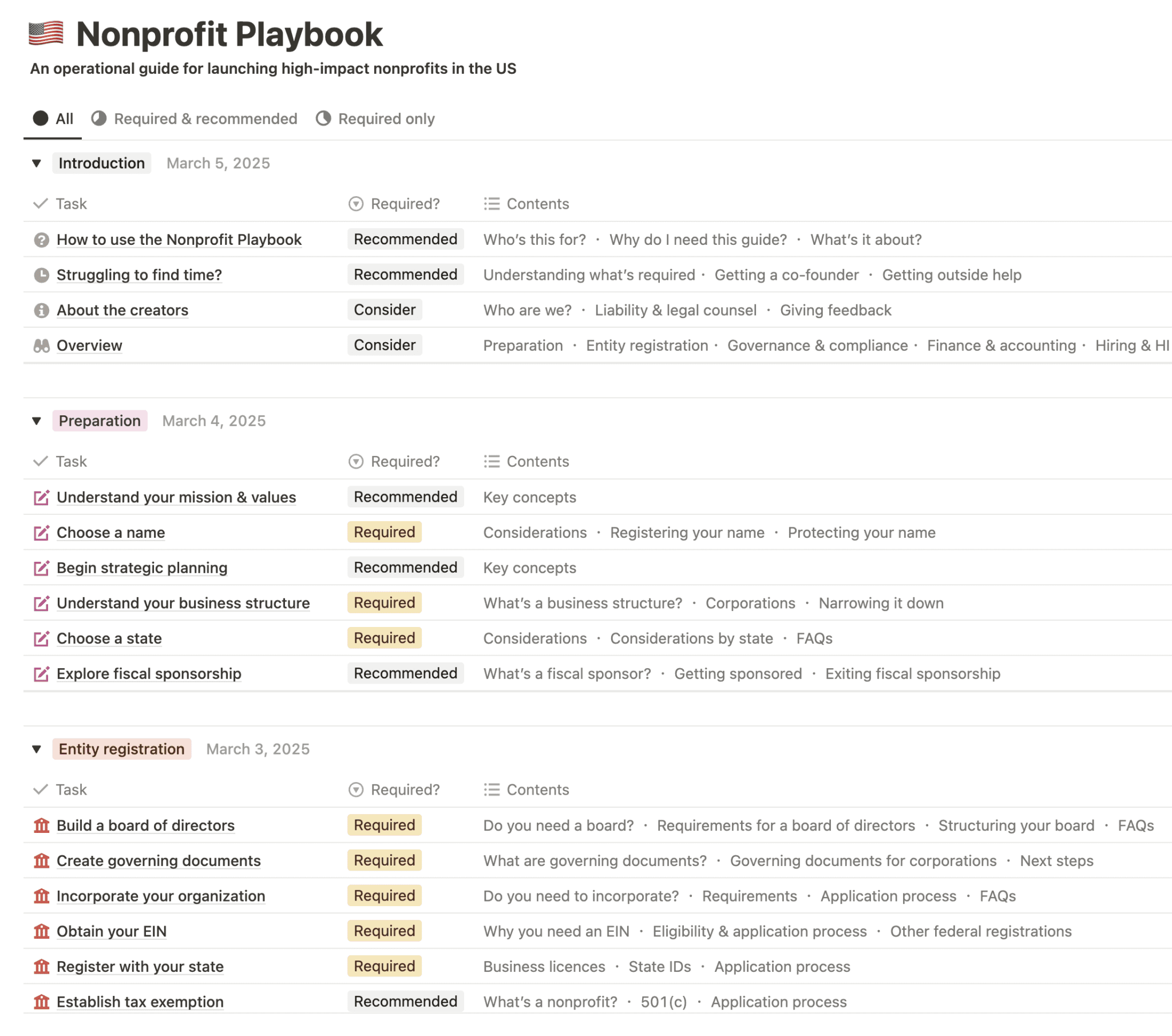
A “Choose Your Own Adventure” Approach
We understand that launching a nonprofit is overwhelming enough without adding a 200-page manual to your reading list. That’s why Impact Ops structured this playbook as a “choose your own adventure” resource. Struggling to find time to figure out what you need to do? Start with the legally required minimums. Confused about governance or looking for a starting point to build a budget? Jump straight to the board development section or “create a budget” section.
This playbook is deliberately focused on operations – the engine that keeps your nonprofit running. It complements other excellent resources like Erika DeBenedictis’s quick-start guide for research nonprofits and similar specialized guides. We encourage you to share additional resources in the comments that have helped your journey!
We’ve already seen organizations in our network benefit from these resources, and we’re excited to make them available to the broader nonprofit community. We hope this playbook saves you time, reduces stress, and helps you build a solid operational foundation for your important work.
Have any suggested edits or additions of other great operational resources for nonprofits? Email us.
At Astera, we’re seeding an ecosystem of mission-driven, open-first tools, people, organizations, and products to ensure that the abundance unlocked by rapid technological progress is shared broadly. One of the principles we’ve adopted in service of this mission is radical transparency – we’re committed to doing all we can to make it easy for others to follow, reuse, and improve on whatever we do, even in cases where the results of our work aren’t compelling.
In this piece, we describe a workshop on scaling synthetic biology that we co-hosted with Metaculus back in June, titled “Scale is All You Need.” The workshop brought together professional forecasters with entrepreneurs, investors, and experts in synthetic biology in an attempt to work both backwards from shared objectives and forwards to forecast the anticipated effect of potential interventions. Our goals were (1) to identify a set of technical innovations or scientific insights that, if developed, could help resolve the bottlenecks that currently make it difficult for synthetic biology companies to scale to compete with traditional products and (2) to identify and discuss critical points of disagreement between experts’ models on this topic.
As discussed below, we found that the specific outputs of this workshop were not well suited for our particular purposes. However, we believe this workshop format has promise in general, and we would consider running a similar event in the future with modifications. This brief piece is intended to catalog (1) what we did and what we would recommend changing, (2) the materials (including templates and guides) we developed for the event, so others can use or build on them, and (3) the substantive outputs of the workshop, which may be helpful to others thinking about synthetic biology scaling even if they weren’t well calibrated for our own uses.

The process we used had four stages:
- Defining specific, quantitative objectives: What large-scale outcome do we hope to see in the world over a significant time scale?
- Example: “reduce the use of synthetic nitrogen fertilizers by 30% by 2050”
- Identifying bottlenecks: What blockers, if resolved, might allow those objectives to be met?
- Example: “high annual cost of biofertilizers”
- Proposing interventions: What specific, actionable innovations would help resolve those bottlenecks?
- Example: “a genetically engineered microbe that can fix atmospheric nitrogen at 50% higher efficiency than natural bacteria”
- Forecasting potential impacts: If the intervention is successfully implemented, what effect is it likely to have on the ultimate outcome we care about?
- Example: “If a genetically engineered microbe that can fix atmospheric nitrogen at 50% higher efficiency than natural bacteria is created by 2030, will the use of synthetic nitrogen fertilizers decrease by 30% by 2050?”
The methodology is described in further detail in the Metaculus writeup of the event, and our Facilitator’s Guide and templates to guide workflows (here, here and here) may be of use to others wanting to build off this method.
We hoped that by focusing on such granular, concrete forecasting questions, we would be able to limit the number of implicit assumptions that affected participants’ forecasts, and as a result to identify the load-bearing places in which participants’ models, and the beliefs underlying them, actually diverged.
Results
In practice, the results were mixed: Time constraints and the participants’ lack of familiarity with forecasting made for a decent amount of chaos and confusion (despite the participation of Metaculus professional forecasters), and this led to a situation where many of the forecasting questions were not well scoped to address scaling challenges. If we were to run another event in the future, we would likely experiment with doing either the first 3 phases or the last one asynchronously, to allow more rounds of iteration on the forecasting questions and to make sure people were comfortable with the methodology. Additional lessons are addressed at the end of Metaculus’s writeup.
Despite the limited usefulness of specific forecasts, the work of identifying objectives, bottlenecks, and potential interventions did generate a potentially useful set of common themes as well as points of disagreement between the experts’ models. Below is a summary overview of the six themes, as well as links to more detailed distillations of each group’s work by science writer Stephen Thomas:
- Innovation in Biologics has the potential to address significant unmet needs in health. Bottlenecks around manufacturing cost, quality, and yield were discussed in particular.
- Improving crop yields and nutrition has the potential to enhance food security and agricultural sustainability, but is limited by challenges with limited data, long engineering cycles, and the difficulty of domesticating more climate-resilient crops.
- Plant-based proteins have been proposed as a solution to reduce the environmental impact of food production while meeting global protein needs, but price and quality have largely not yet been competitive with traditional animal proteins.
- There are a wide range of biotechnology-based methods for carbon capture and storage for mitigating climate change, spanning enzymatic processes for carbon fixation and enhanced rock weathering, as well as limiting methane released from animal agriculture and waste treatment.
- Biomaterials have a lot of potential for performance and sustainability across many markets, and the group focused on challenges in product and market development for novel materials.
- Bioproduction of clean chemicals can reduce or eliminate the use and generation of hazardous substances, but is limited by feedstock availability, high costs, and limited scalability of biological processes.
This initial experiment in collaborative forecasting yielded valuable methodological lessons and identified key themes in synthetic biology’s potential impact. In line with our commitment to radical transparency, we’ve shared both our process and outcomes—successes and shortcomings alike. Rather than an endpoint, we view this workshop as the beginning of an iterative process to develop better tools for navigating technological acceleration. We invite others to build upon these frameworks, adapt our templates, or suggest entirely new approaches as we collectively work toward a shared vision of technological abundance. By openly sharing our work and learning in public, we hope to catalyze a broader ecosystem of collaborative forecasting tools and practices.
The path for building new technology is never straightforward. Exploring new ideas, new approaches, and new business models means navigating paths that ultimately don’t bear fruit. At Astera, we believe in shining a light on what it takes to explore these paths, opening up the process and providing catalytic resources for people navigating at the edge of emerging technologies.
This includes opening up about aspects of the journey that no one really wants to talk about.
90% of startups ultimately fail, a statistic that is as scary as it is inspiring—founders choose to take on new ventures despite these odds. Failure is a necessary part of making new things, but failing well takes courage and foresight to do what it takes to wind down a company in a way that informs and empowers future efforts. We were honored to support Kasia Gora and Josh March, co-founders of SciFi foods, to share their experience of winding down their company, providing a guide for others who will find themselves in the same position. After five years and raising $40M from top investors, the shifting market environment brought them to the end of the road. They wanted to share what they learned from this difficult process with the wider community of founders and innovators.
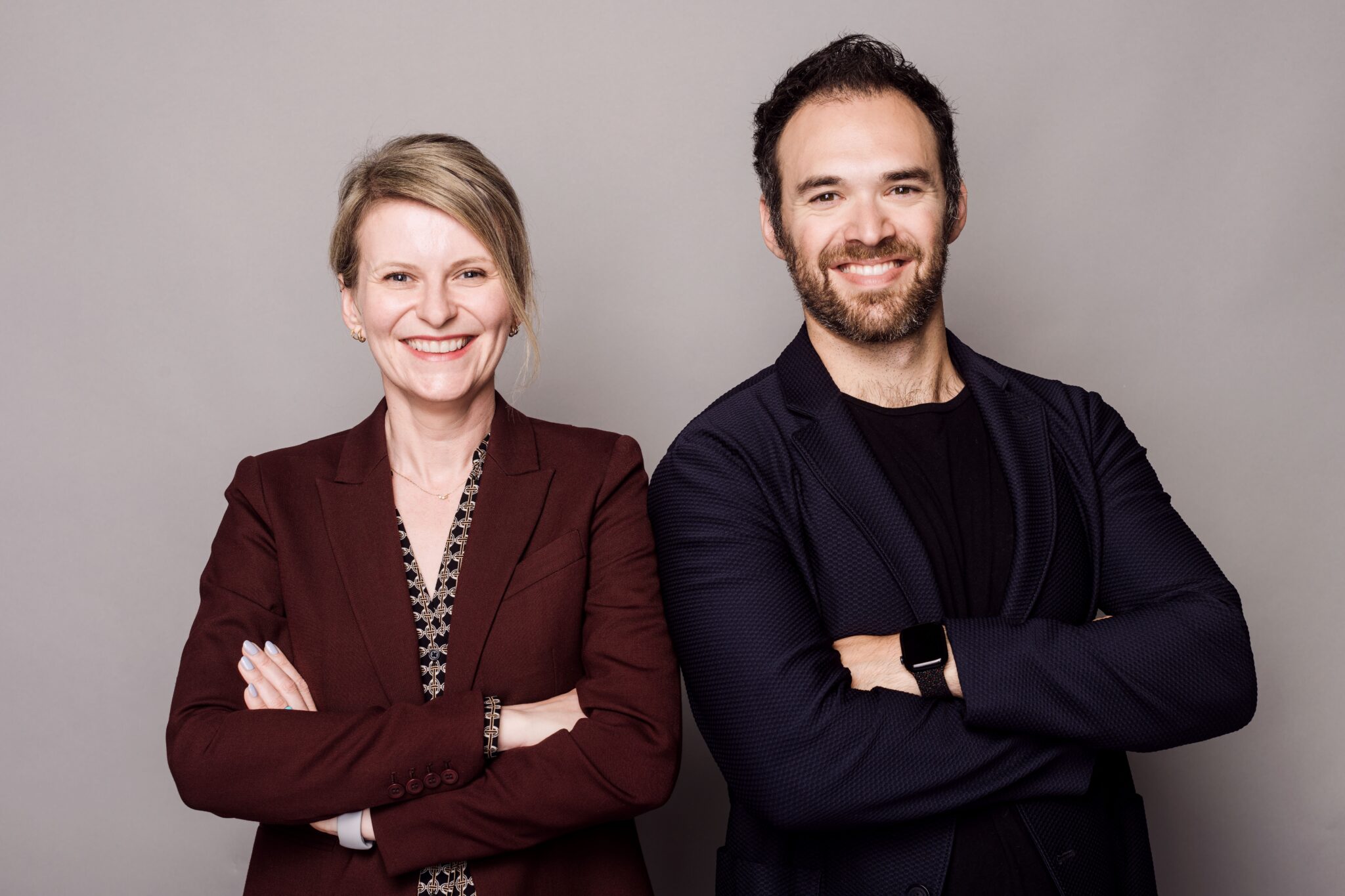
In the white paper (PDF link), you’ll find a resource for building your plan A, plan B, and the plan you may not want to execute but will be happy to have written. Kasia and Josh provide step by step guidance for what to do as you approach the end of your runway, how to think about your legal responsibilities, and how to navigate communicating with investors, employees, and other stakeholders during this challenging time.
Failure is an inevitable part of how technologies are made, but broad learning from the companies that wind down is anything but. Today, enormous amounts of important and socially valuable science, information, and IP disappears when companies wind down, locked away in private repositories and models, personal anecdotes, or simply lost. We are eager to support work like Kasia and Josh’s towards preserving this knowledge and keeping it open. If you are a founder with resources that you’d like to share, please reach out.
Download the PDF white paper here.