
The Astera Institute is excited to launch a major new neuroscience research effort led by Dr. Doris Tsao, who will be joining as Chief Scientist for Astera Neuro. We seek to understand one of the deepest mysteries of science: how the brain produces conscious experience, cognition, and intelligent behavior. Astera will support this effort with $600M+ over the next decade.
Doris has spent her career developing one of the most detailed accounts of how neural activity gives rise to perception through work on the neural code and circuitry underlying face and object recognition. This work shows how a complex visual percept, object identity, is represented by a principled geometric code. Her recent work explores a new computational framework for how symbols first arise in the brain through specialized circuits for object tracking.
What are we doing?
Across every moment of our lives, the brain transforms raw sensory input into a coherent world filled with objects, relationships, meanings, and a sense of self. Yet we still do not understand the fundamental computational principles the brain uses to construct this internal world. Uncovering these principles would transform both neuroscience and technology–revealing the mechanism responsible for generating conscious experience, and at the same time, providing a new framework for AGI.
At the heart of our new effort is the conviction that true understanding of the brain’s internal model means being able to manipulate it in a controlled way. Towards this goal, we are betting that the brain’s representational architecture is compositional, built from elemental units and a neural syntax for combining them. By identifying these fundamental units and the rules that create and link them, we can uncover the brain’s infinitely generative internal code. This, in turn, would provide a principled way to construct or modify internal representations, much as knowing the words and grammar of a language allows the creation of an unlimited range of sentences and meanings. Such capability would mark a profound advance in understanding.
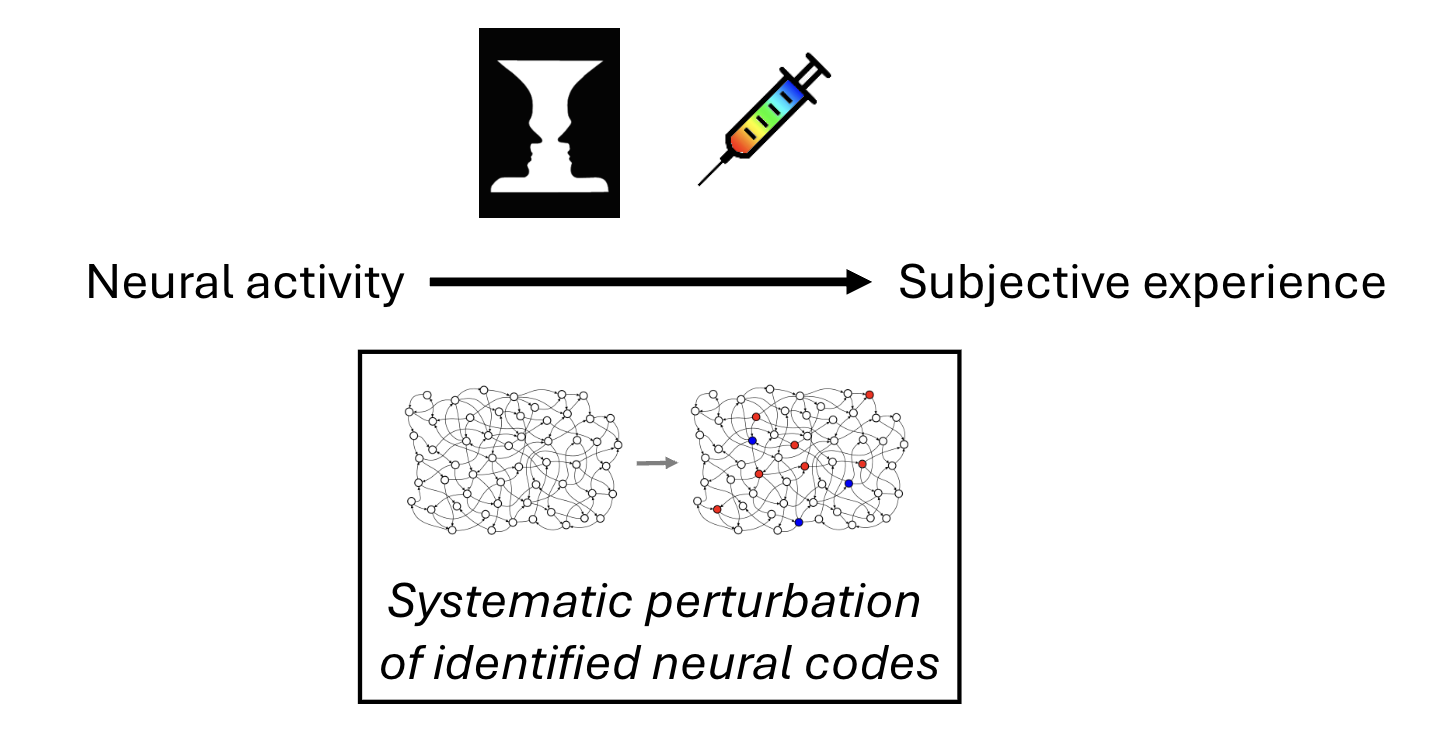
The compositional framework remains a hypothesis, but pursuing it opens a path for fundamentally new kinds of experiments. The first step will be to measure neural activity through large-scale recordings across a rich variety of stimuli and behaviors, allowing us to characterize the underlying neural code. We will then attempt to write in hypothesized neural codes and thereby construct or alter internal representations according to proposed compositional rules. In this way, we can move neuroscience beyond passive observation and towards active, engineering-style tests of a model. Whether or not our hypothesis proves fully correct, this approach will accelerate our understanding of how the brain’s internal model is built.
A field ready for a paradigm shift
The ability to precisely map and modify the brain’s internal model may sound like a lofty goal and indeed, for decades, progress in neuroscience was limited by technology. But that barrier has largely fallen, and we believe now is the right time for our moonshot. We now have the tools to interrogate the brain at unprecedented resolution and scale.
What is needed next is a coordinated engineering effort to fully harness these tools. Advances in large-scale neural recording, targeted stimulation, chronic high-density interfaces, and computational modeling have created a unique moment where a focused, non-clinical, scientifically driven program can push far beyond what academic labs or clinically oriented companies alone can achieve. We intend to fill this essential gap between traditional basic research and clinically driven neurotechnology.
Progress towards our goals opens major branches of independent inquiry:
- Inspiring new approaches to building and steering AI systems: Understanding the brain’s computational strategies—the architectural principles and representations—could reveal fundamentally different approaches to building AI systems that are orders of magnitude more efficient and naturally aligned with human cognition. Industry pursues only a narrow slice of what’s possible. We believe reverse-engineering the only generalized intelligence in existence could open up new pathways to general artificial intelligence.
- Deepening our fundamental understanding of biological intelligence and conscious experience: The brain is one of the universe’s wonders. What is the structure of neural activity required for a specific experience? What are the primitives of perception and thought? How does the brain represent itself? How do disruptions in the brain manifest as psychiatric and neurological conditions? We seek to develop a theory of conscious experience that successfully predicts the experiences that emerge when we write specific patterns to the brain.
- Opening pathways to revolutionary neural interventions: Today’s brain-machine interfaces work at the periphery, translating motor commands or delivering basic sensory inputs. But understanding deeper computational structures could enable interfaces that engage with the brain’s core representational system. This could have major therapeutic applications, for example, a visual prosthesis for the blind that restores vivid, naturalistic visual experience, not just pixelated sight.
Why Astera is pursuing this work
Since the founding of the Astera Institute in 2020, Obelisk, Astera’s AGI research program, has pursued the hypothesis that a better understanding of how intelligence arises in natural systems could reveal computational principles missing from current AI paradigms. The brain achieves flexible, general intelligence with roughly 20 watts of power. It constructs everything we experience—every object we see, every thought, every feeling—from patterns of electrical activity across ~100 billion neurons. It learns continuously from sparse data. It plans, imagines, and constructs a coherent model of the world. We don’t yet understand how.
Astera Neuro brings deep experimental neuroscience into direct dialogue with this work. We hope to create a tight iterative loop across teams where experimental findings shape AI architecture research, and computational questions drive new lines of neuroscientific inquiry.
We believe Doris has developed what may be the most detailed empirical account of how neural activity produces perception so far. The potential of her work requires long-term investment. We are excited to work with Doris to test her model and systematically explore how the brain constructs reality in direct collaboration with Obelisk engineers and researchers exploring alternative approaches to AGI. The iteration between these basic and applied research efforts will surface things neither could find separately.
Research will be shared exclusively outside traditional journals as a forcing function for developing faster, more open, and more useful outputs that represent the full scientific process. As we’ve seen with other efforts, we believe such an approach will enable greater alignment of scientific goals and values across the team. We will also be iterating on ways to make these outputs more compatible with AI-driven discovery.
Building the team
We are excited for the opportunity to build this moonshot. We have a chance to experiment with how science can be done by designing our team and approaches in a purposeful way. This work requires capabilities that don’t typically collaborate as part of a cohesive iterative circuit at an institutional scale: neuroscientists who can design experiments on complex natural behaviors, ML engineers who can build models from massive neural datasets, optical engineers working on holographic optogenetics and advanced imaging, systems builders who can create scalable experimental infrastructure, and metascience innovators dedicated to accelerating all aspects of this work.
Doris brings decades of foundational work on neural coding. For her next chapter with Astera, she is joined by an exceptional founding team (soon to be announced) whose contributions span large-scale reading and writing to neural circuits, clarifying the neural basis for cognition, and understanding brain function during naturalistic behavior.
We are now looking for a Chief Operating Officer who will work in direct partnership with Jed and Doris to transform their scientific vision into operational reality. They will be orchestrating collaboration across disciplines, building systems that support both rigor and speed, and helping create an organization capable of tackling problems at this scale.