Thousands of feet below the surface of the Pacific Ocean, a sea sponge produces threads that lattice together into a translucent skeleton. A foot-long glass house of their own design. When Tim McGee, now a resident at Astera Institute, learned about this creature — the Venus flower basket — in 2003, it changed his career. McGee left a job in pharma to work with a lab studying how sea sponges could do such a thing. It was an amazing feat of manufacturing completely unlike anything human technology could do.
“It just kind of melted my brain that at the bottom of the ocean there’s these creatures that are spinning glass, whereas we have forges at thousands of degrees,” McGee said. “It’d be amazing if we could do that.”
McGee has since devoted his career to learning from nature’s ingenuity and the power of proteins.
When nature assembles proteins carefully at the molecular scale, it creates strong, responsive, and smart fibers, because proteins can sense and respond to their environment. It’s a sort of material intelligence. But our manufacturing falls short. Our usual fibers don’t have the variable attributes that proteins do; and when we do try to build with proteins, our fiber assembling processes fall far short of nature.
We cannot yet program the exact combination of properties we need, be it strength, conductivity, transparency, and so on. Think of robots actuated by fibers that move like our own ligaments and compute a sense of touch. “How can proteins basically be a way for us to make almost anything?” McGee said. In his residency with Astera, he is working toward that future.
McGee’s Impossible Fibers program is creating a manufacturing technique to make protein fibers that more closely mimic nature’s tactics.
“We know nature can create tunable structures,” McGee said. “The question is, how do we start to get there? And how can we get there quicker?”
The problem with traditional fiber spinning
If you want to spin fibers out of proteins today, your options are limited. Manufacturers either melt and resolidify polymers (melt spinning) or extrude polymers from one solution into a bath that coagulates them into thin filaments (wet spinning). Neither method allows for adequate molecular assembly of proteins. They instead essentially force a material into a particular alignment. Whatever special attributes they need must then come from the usual chemistry levers: high or low molecular weight polymers and potentially toxic additives introduced after spinning.
But proteins are too finicky for this approach. Proteins want to align and bond in their own particular way. “The way that we manufacture today is akin to just supergluing everything together and throwing it out there, as opposed to actually assembling the Lego bricks,” McGee said.
With Impossible Fibers, McGee is seeking more control over how proteins assemble in space and time.
More precise control with encapsulation
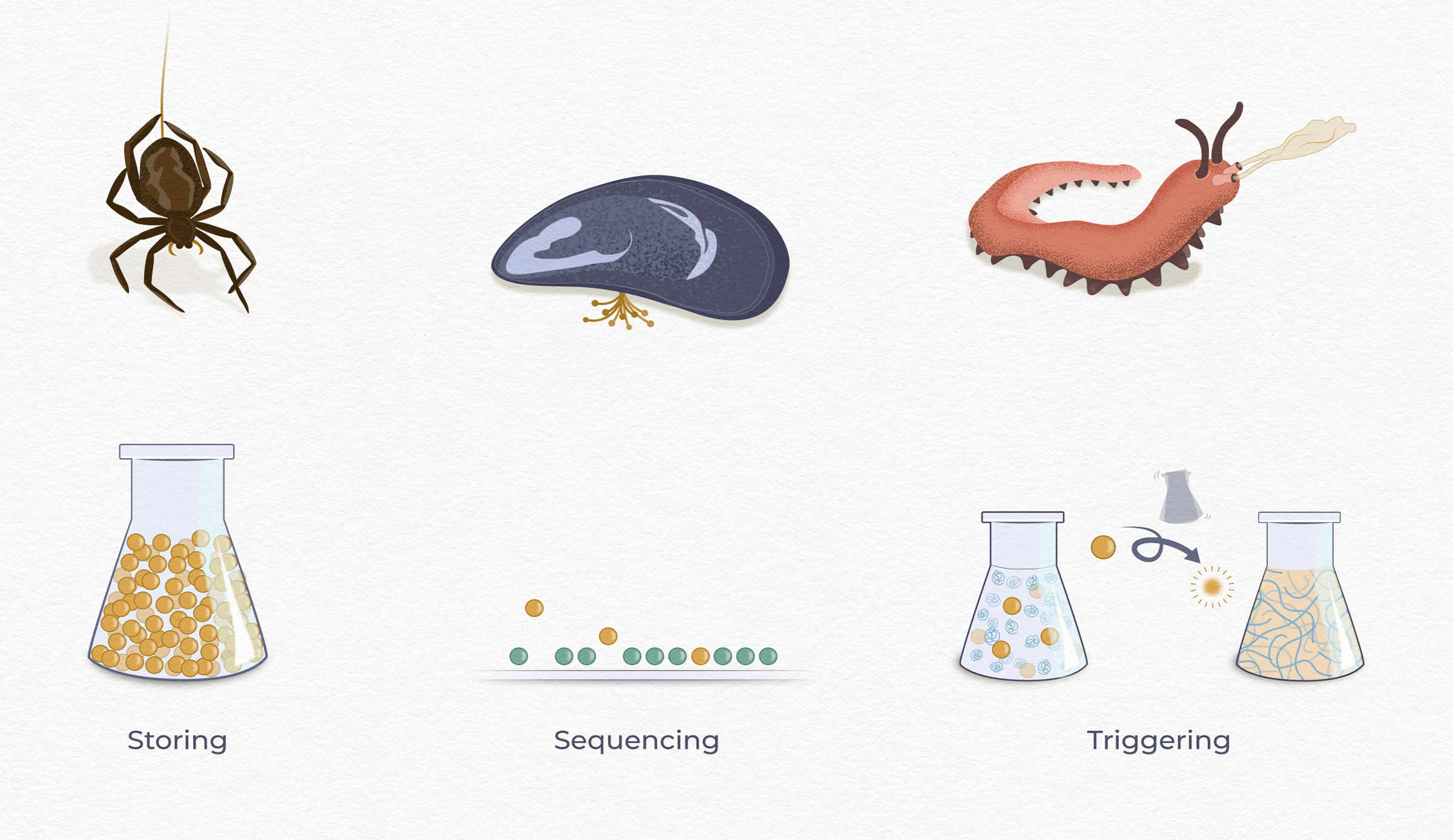
Impossible Fibers’ proposed system begins with “encapsulation,” inspired by how creatures like spiders, mussels, and velvet worms store, sequence, and trigger protein assembly.
The team is prototyping a three-part platform. First, a microfluidic device encapsulates small droplets of dissolved proteins, transforming them into stable droplets. The droplets can then be arranged, sorted, manipulated and programmed into desired arrangements, like beads on a string that program how the material is assembled. A third device then bursts the droplets and precisely assembled fibers from its proteins.
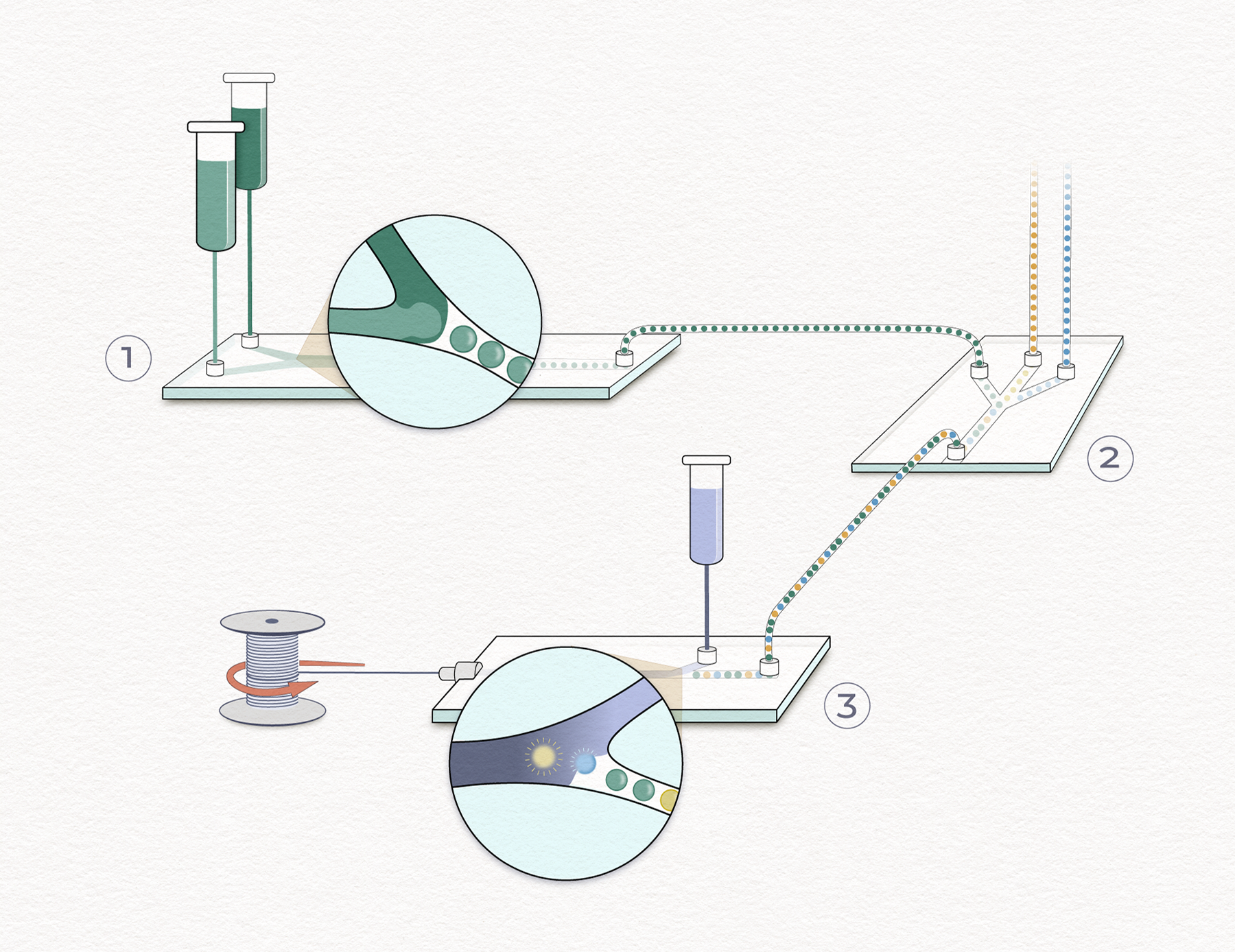
“You can pop them at the right moment,” McGee said. “So we do reactions in this microfluidic device, and then we pull a fiber out of the other end.”
This is the kind of control that scientists often see in nature’s high performance fibers.
Encapsulation gives unprecedented flexibility
McGee envisions the same encapsulation platform for programming fibers out of any number of different proteins. And that generalizability is important.
Fibers are everywhere, and the need for high performing multi-functional fibers is everywhere as well. Companies have spent decades trying to engineer spider silk for strong, lightweight materials. And the upside is about more than strength. AI companies would benefit from hollow core optical fibers which transmit data through narrow tunnels of air, rather than glass; roboticists would benefit from strain-sensing and conductive filaments which could unlock proprioception and more human-like function. “Whether it’s optical, electrical, mechanical, chemical, or just adaptable,” McGee said, “All those things you can do with proteins.”
It’s unrealistic to expect a one-size-fits-all fiber spinning platform. But this type of encapsulation platform gives manufacturers an unprecedented generalized step inspired by nature to begin protein assembly.
Why here
Impossible Fibers is following in the footsteps of prior Astera residents, by identifying a daunting bottleneck that, if resolved, will ripple transformation across tech sectors that would not have the opportunity to innovate so drastically.
Impossible fibers is the quintessential project that falls in the gap between academia and industry. Academic labs have shared some of Impossible Fibers’ ideas, but seeing that vision through requires a scope and scale beyond academia’s abilities. On the other hand, venture investors won’t touch a high-risk capital intensive project without a clear, focused application. But that’s precisely why previous protein fiber groups have failed: they are forced to use existing manufacturing in order to fit existing markets, effectively abandoning the unexplored terrain that made proteins interesting in the first place. The unique advantage of Astera is that philanthropic resources can de-risk these “boring” process components overlooked by traditional investment, while also taking bigger swings than what’s possible in academia. It’s the starting point for investors to see what might be possible if we invested in novel manufacturing through Open Science. Other labs or start-ups can then build on our work to advance the thousands of possible areas of focus.
“It’s kind of a rare program where they give you a salary and a stipend to build a lab to let you build out this capability,” McGee said. As an Astera Resident, McGee’s Impossible Fibers program will challenge old ideas of what fibers can be and what they can do. Multifunctional fibers could trigger a new era in robotics and unlock more durable and effective medical devices. McGee expects protein fibers to find use as implantable brain electrodes that more reliably match the soft, strong, conductive environment of nervous tissues.
Building openly, for now and the future
As Impossible Fibers works towards catalyzing fiber tech and new applications in the year with Astera, they are designing with open science in mind. The team is developing new microfluidic designs, new tools to prototype fiber spinning, and new methods to assess the protein fibers they spin. “Everything we are working on is open,” McGee said. “We believe this can foster a community of people to explore this exciting new frontier.
Why is this technological transition possible today, rather than five years ago or five years from now? For one, laser etching and 3D printing costs have decreased. But perhaps more important is the feedstock. We can make larger quantities of biopolymers — the building blocks for programmable materials — than ever before. Engineered bacteria can produce interesting proteins found elsewhere (and nowhere) in nature. Prototyping that previously would require millions of dollars and years of development can now be tested in weeks for tens of thousands.
It’s therefore urgent that we invent new manufacturing processes for this next generation of materials.
McGee hopes the work will lead to predictive algorithms to assist in biomaterial design. “It’s the vision of the far future,” McGee said, “of being able to ask an AI, I want a material with these properties, give me the protein and the manufacturing sequence to enable that to happen.”
This potential to master protein design may even allow us to surpass what nature can do. “Nature is not a perfect solution,” he said. Evolution is a messy, path-dependent process of incremental steps. The goal of Impossible Fibers is to extract the math, physics, and chemistry behind the most clever phenomena. “If we want to make the future faster, we have to figure out how to compress what we can learn from the natural world into our own technologies.”
Want to dig deeper? Visit the impossiblefibers.com and follow along at iflab.substack.com