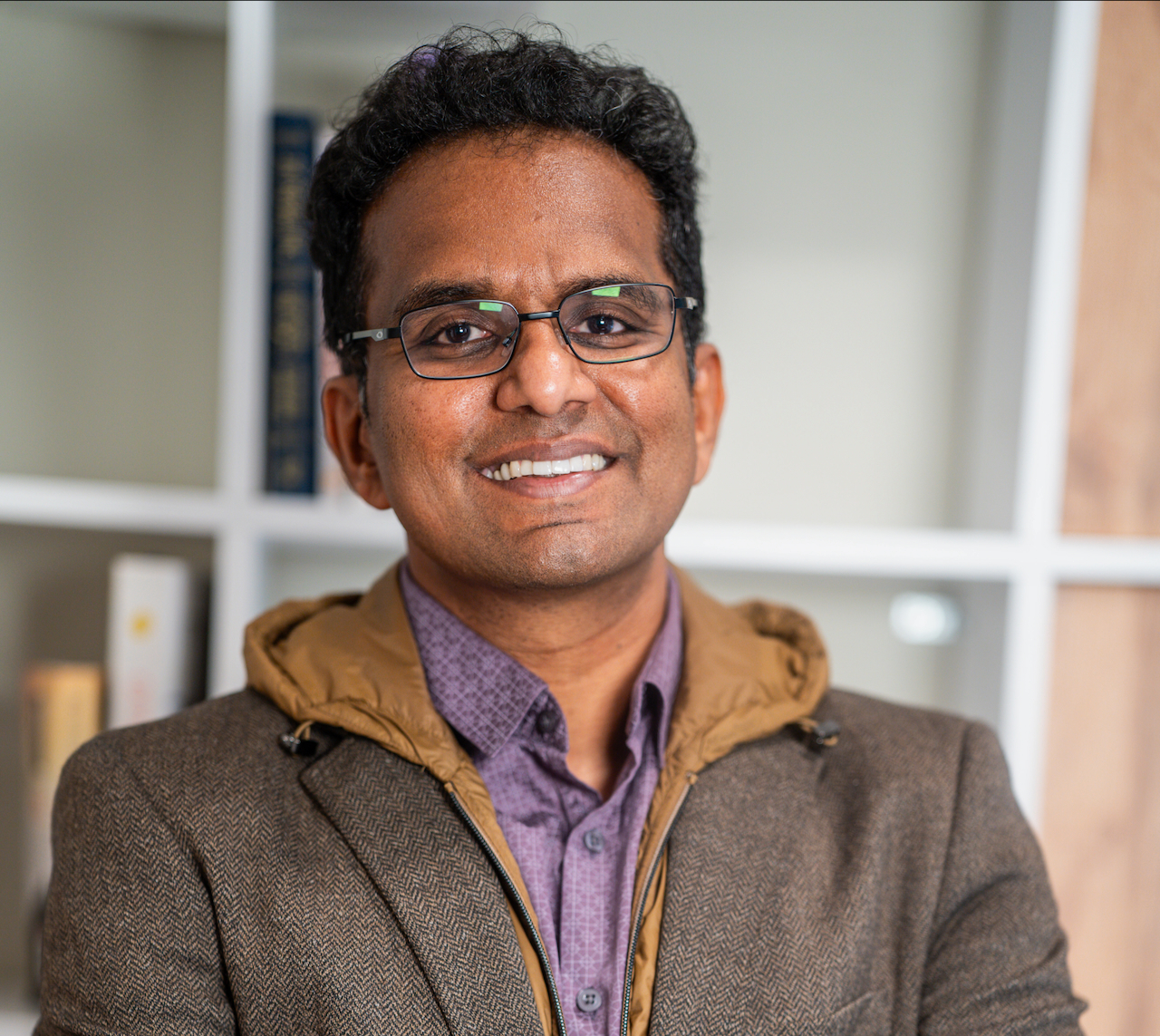
Dileep George is joining Astera as Head of AI, leading our AGI research division. Working alongside our Chief Scientist Doris Tsao, he and the team will explore novel, brain-inspired computational architectures to accelerate the development of safe, efficient and aligned AGI. Astera will continue to support this effort with over $1 billion in committed resources over the coming decade.
Dileep joins from Google DeepMind, where he worked on frontier AGI research on agents with memory, planning and structure learning. Throughout his career, Dileep has shown that drawing on the computational principles of biological intelligence opens up novel, high-impact pathways for AGI research. At Vicarious, he scaled algorithms for visual processing and reasoning, gaining worldwide attention for breaking text-based CAPTCHAs with human-like data efficiency. He also pioneered AI-powered robotics as a service for industrial applications. At Numenta, he co-developed Hierarchical Temporal Memory, the theoretical framework modeling how the neocortex learns and reasons.
Dileep joins Astera alongside Miguel Lázaro-Gredilla, previously a Research Scientist at Google DeepMind. As Research Lead, Miguel will spearhead the development of world models that utilize hierarchical latent variables for long-horizon planning and robust reasoning.
Neuro-inspired AGI research is underexplored relative to its potential
The overwhelming majority of AI research today pursues a dominant paradigm: scaling transformer architectures trained on massive datasets. This approach has produced remarkable results and will likely continue to do so, but concentration around any single research direction leaves promising alternatives underexplored.
The principles of biological intelligence likely offer novel approaches to AI engineering at scale that aren’t captured in existing research paradigms. This could help address two sets of challenges that remain on the path to AGI:
1. Current AI systems lack fundamental capabilities that biological intelligence demonstrates. They can’t handle long-range planning that requires maintaining coherent goals across complex action sequences, or learn continuously from experience the way humans do. Massive datasets are still required for tasks where humans need only a handful of examples, and they continue to fail to generalize robustly to situations that differ meaningfully from their training data.
2. The safety and alignment challenges posed by current architectures remain unsolved, even as we continue to scale them. We don’t yet know how to build systems whose goals stay aligned with human values as circumstances change in ways they weren’t trained for. We can’t reliably interpret why models make the decisions they do, which makes it difficult to predict or prevent failures.
Commercial investments currently concentrate on scaling transformers, which risks trapping the field in local minima: optimizing a single approach while leaving vast parts of the solution space unexplored. Biological intelligence offers computational principles that current architectures don’t capture, opening pathways to systems that are more efficient and more naturally aligned with how humans think and perceive.
Bridging neuroscience and AI engineering
Efforts to map biological intelligence — how the brain constructs perception, cognition, and intelligence itself — remain disconnected from the engineering of AI systems. Neuroscience and AI research proceed largely in parallel with limited integration.
Providing decade-scale commitment and computational resources, Astera is running two research programs in tight integration:
- Decoding the brain’s computational architecture: Led by Doris Tsao, Chief Scientist for Astera Neuro, our Neuro division is working to decode the fundamental mechanisms through which the brain constructs intelligence. These capabilities represent some of the hardest unsolved problems in AI, and the brain solves them with remarkable efficiency.
- Building AI systems that learn like humans do: Now led by Dileep, our AGI division tackles the research and engineering challenges of building systems that exhibit these capabilities: how intelligent agents adapt continuously to changing environments, correctly attribute rewards to actions in scenarios with sparse feedback, and build hierarchical memory systems that enable efficient retrieval and generalization.
Dileep and his team will work closely with Doris, whose work has revealed some of the most detailed accounts of how neural activity produces perception to date. Together, they hope to create an iterative research program where neuroscience discoveries inform engineering approaches, and engineering challenges surface new neuroscience questions. Going forward, we hope to see others more tightly link basic neuroscience and applied AI work.
This work will be conducted in line with Astera’s broader commitment to open science. We believe progress on AGI is better served by distributed work across the field than by locking insights away.
The team this requires
We’re now building a team whose capabilities span deep theoretical investigation of biological intelligence, large-scale ML systems engineering, and experimental validation of novel architectures.
We’re actively looking for researchers and engineers with strong machine learning backgrounds and deep curiosity about neuroscience: people who want to investigate what’s missing from current approaches and build something better.
If this vision excites you — whether you’re a researcher, engineer, or someone who wants to work on foundational questions about intelligence — we want to hear from you.
There’s always a need for more ideas and talent in this area. If you have an interesting, underexplored angle you’d like to chase down, we’ve also recently opened a call for applications to the Neuroscience and Artificial Intelligence tracks of Astera’s residency program. Our residency is meant to support talented innovators seeding early-stage projects, especially those that might sit outside of what’s conventionally pursued. We’re building a community here that could be a great hub for this type of exploration. We hope you will consider applying.